What the analysis finds
- Three independently biased censuses agree on the same shape: YFull's curated tree (99 ancient men below Z94), our AADR v66 audit (138), and an independent community re-analysis of the 2026 Akbari release (145) all put nearly every ancient carrier on the Z2124 arm — and none at or below L657, the arm that dominates the modern subcontinent. A fourth, sequence-level lens added in revision (FTDNA Discover's re-calls; Andreeva 2025) places a dozen pre-CE men on the Y3 side outside these censuses: measurement, not migration, made the arm look absent.
- The Z2124 share of sampled ancient Z93 rises through time — 0% before Sintashta, ~51% in the Sintashta–Andronovo era, ~67% in the Scythian–Saka–Xiongnu era, ~70% in the Migration era — while sampling geography sweeps east to Kazakhstan, Xinjiang and Mongolia, then boomerangs west to Hungary with the Hun–Avar movements. The direction replicates in two disjoint call pipelines (p = 0.047 audit, p = 0.012 register); the exact percentages carry coverage and burial-visibility confounds and are not read as demography.
- The modern map splits clean: L657 is India–Pakistan–Sri Lanka–Bangladesh (Panjabi plurality among testers); Z2125* is Pashtun–Baluchi; S23592 peaks in Kyrgyzstan; Z2122 carries the Ashkenazi Levite cluster westward — and the apparent Z2123 "Caucasus peak" is largely one intensive testing project, a bias we publish rather than the geography.
- The 2026 Akbari release publishes no Y-haplogroup calls. Its own tables carry no Y column and anonymize the country of all 9,497 new individuals; every circulating "Akbari Z93 map" is downstream re-processing of the raw sequences by third parties.
- Migration claims are graded, not asserted — a four-model interpretation panel converged on eight steps and, just as usefully, on three claims this data cannot license.
Start With One Man
Around 801 BCE, a man was buried at Butkara II in the Swat valley of what is now Pakistan. His Y chromosome places him on the Y3 arm of haplogroup R1a-Z93 — the arm that today includes L657, the largest R1a lineage of South Asia, carried by tens of millions of men from Punjab to Bengal to Sri Lanka. In the ancient record this analysis assembled from AADR v66 genotypes — 212 sampled Z93 males spanning four thousand years — he is the only man before the common era who sits on that arm. Hold that singularity loosely: it will turn out to be a fact about the measuring instrument as much as about the past.
Everything else in this analysis radiates from that asymmetry. The arm that owns the modern subcontinent is nearly invisible in the ancient record; the arm that fills the ancient record — Z2124, the East-Iranian branch — is a minority almost everywhere south of the Hindu Kush today. This page measures that inversion across five datasets that fail in different ways, charts it, stress-tests it, and ends with graded guesses about the migrations behind it — and the future samples that would kill each guess.
Every Ancient Z93 Man, in Time
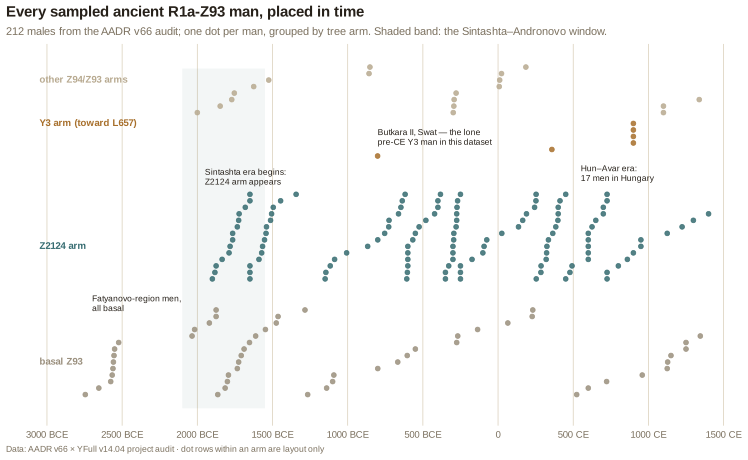
Three features carry the story. The nine men older than the Sintashta horizon are all Russian forest-steppe burials on basal lineages — the Fatyanovo–Abashevo world of the Volga–Oka. The Z2124 arm enters the record inside the Sintashta–Andronovo window and thereafter dominates it: the Tamir Ulaan Khoshuu Xiongnu cemetery alone contributes sixteen R1a males (ten Z2125, four Z95; Keyser 2020). And within this dataset the Y3 arm's ancient silence is broken exactly once before the common era — the Butkara II man — with a handful of later appearances (the Alai valley, medieval Volga communities). In an independent re-analysis of the 10,016-genome Akbari 2026 release by a community pipeline — necessary because the release itself publishes no Y-haplogroup calls at all — the same structure repeats: 145 men below Z94, the Z2124 arm populated throughout, and L657 absent from the entire call set.
The silence, however, is partly the instrument. The 1240k genotype panel behind the audit barely covers the Y3 arm's defining markers — the marker-discard problem quantified in the method section — and where whole Y sequences have been re-called, the arm fills in. FTDNA's Discover tree, which re-processes published ancients at sequence level, places a dozen pre-CE men on the Y3 side: one at Y2 itself around 1795 BCE (an Akbari-release sample whose geography the release withholds), the Nepluyevsky Srubnaya teenager b8-2 (~1760 BCE, southern Urals), and — crucially, in the west — Iron Age men of the Middle Don forest-steppe: a Scythian at Kolbino I (~375 BCE), two men at Semiluk, and a Sarmatian at Nesvetay. The first three are from Andreeva and colleagues (2025), who report R-Y2, the direct parent of L657's block, as one of the two predominant lineages among their Middle Don males — the other, R-Y2631, sits on the Z2122 side, so both arms were present in the western steppe's Iron Age. The same study finds no direct paternal continuity between the local Bronze Age Srubnaya men and these Scythian-era lineages. Butkara II remains the arm's oldest man with a South Asian address; he is no longer its only pre-CE witness.
The Z2124 Arm Takes Over the Record
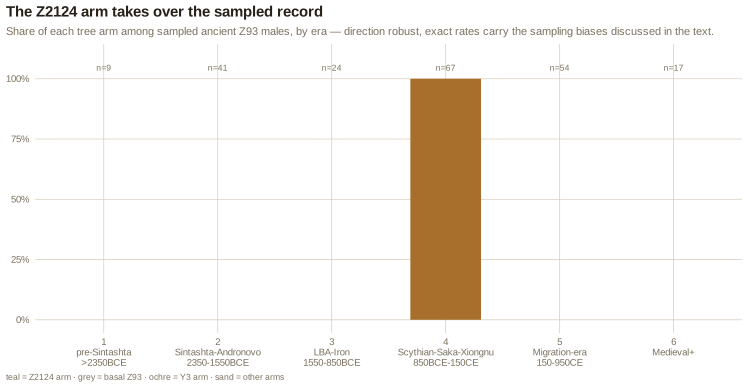
The formal checks (full R output in Method): the logistic trend of Z2124-arm membership on date is significant at conventional thresholds; a correspondence analysis puts 74% of the table's inertia on a single dimension that simply is the time axis; and a west-vs-east test for basal-lineage enrichment returns a clean null (Fisher p = 0.73). What the composition chart cannot say is why — expansion, drift, burial-rite visibility, and coverage improvements in later samples all push the same direction; the robustness assessment quantifies each.
East, Then the Boomerang West
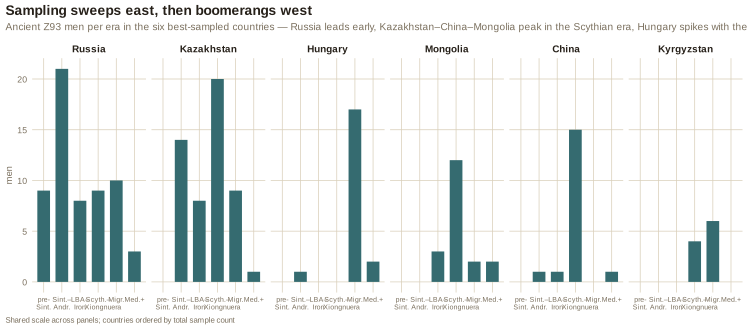
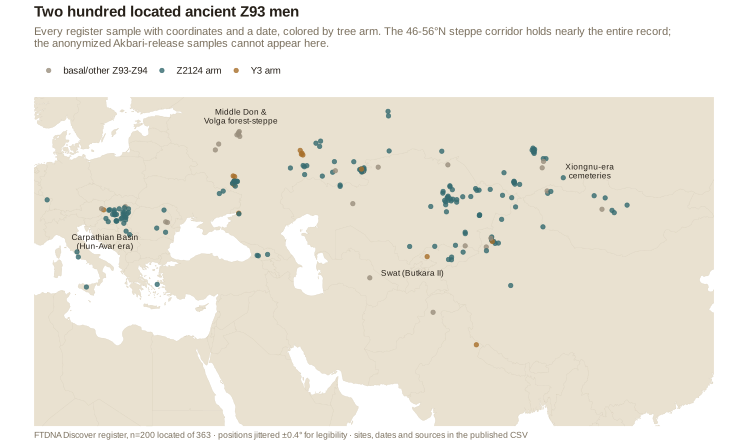
Xinjiang deserves its own sentence: its first Z94-arm man appears at Tangbalesayi around 1566 BCE, an Iron Age site in the Saka horizon carries S23592, and the one genotype-corroborated ancient L657 candidate anywhere — Guanjingtai 7, ~77 BCE, examined at length in the companion article — sits on the same corridor. The eastward sweep is not just sampling: it is also the Saka–Xiongnu world in which these lineages demonstrably lived.
The Modern Map Inverts the Ancient One
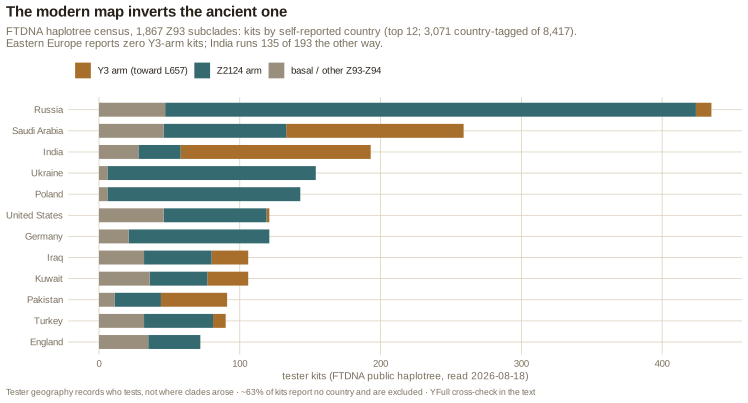
The census behind the chart is the complete FTDNA public haplotree subtree under Z93 — every branch the site's click-to-expand tree can reach, pulled as one file — and its headline is the zero: Ukraine (0 of 154), Poland (0 of 143) and Lithuania (0 of 52) report not a single Y3-arm kit, while India runs 135 of 193 the other way and the Gulf countries carry the Arab L657 cluster (Saudi Arabia 126, Kuwait 29, UAE 29 on the Y3 arm). Tested formally — South Asia's four countries against Eastern Europe's five, Y3 arm against Z2124 arm — the split gives a Fisher odds ratio near 209 (p ≈ 6 × 10−139): whatever tester bias contributes, a signal this size is not recruitment noise. The smaller, independently curated YFull census (1,085 samples) partitions the same way, with strata FTDNA's arm view collapses (mutually exclusive, partition verified to sum exactly): L657 — India 37, Pakistan 16, Sri Lanka 9, Bangladesh 8, with a Panjabi plurality among self-reports. Z2125* — Pakistan 8, Afghanistan 8, Pashto and Baluchi tags leading. Z2123 — the raw counts are towered by Karachay-Balkar (99) and Adyghe (41) self-reports from one intensive Caucasus testing project; we publish that as recruitment bias, not as a Caucasus origin. S23592 — Kyrgyzstan 17, the steppe arm that stayed nomad. Z2122 — England, Yiddish (the Ashkenazi Levite M582 cluster) and Levant flags, the arm that went west.
A small non-random cross-check points the same way: in the public FTDNA Punjabi (India & Pakistan) project, twenty of the twenty-one R1a men among fifty-three with Y results are L657, and the Big Y testers among them resolve into eleven distinct terminal branches. Self-selected tester data, offered as texture, not as a frequency estimate.
Published anchors that survive subclade resolution: Underhill 2015 — 98.4% of Central/South Asian R1a is Z93; Z2125 above 40% among Kyrgyz and Afghan Pashtuns; basal Z93* at 1–8% in every Iranian population and above 30% in the Altai. Haber 2012 — Afghan R1a: Pashtun 51%, Tajik 30%, Uzbek 18%, Hazara 7%. Pamjav 2012 — all 53 of 53 Malaysian-Indian R1a chromosomes are Z93. Chang 2023 — Chinese Hui carry Z93 at 14.4% (Xinjiang Altay) and 10.4% (Ningxia), absent from Hui elsewhere. Behar 2013 carries the regional table behind the Levite story. There is still no caste-stratified Z93 typing for India in the literature — the deepest available resolution for Punjab remains the 1000 Genomes Lahore males, where our audit finds 16 of 44 Y-called men (36%) on Z93 across several deep subclades.
Robustness and Bias Assessment
Every quantitative claim on this page was subjected to an adversarial review and, where a second dataset existed, to independent replication. The table reports each test, its result in both datasets, and the assessment that governs how the claim is worded elsewhere on the page.
| Claim | AADR v66 audit (n = 212) | FTDNA register (n = 362, disjoint pipeline) | Assessment |
|---|---|---|---|
| Z2124 share rises through time | logistic coef −0.27, p = 0.047 | coef −0.281, p = 0.012 | Direction replicated across two call pipelines; magnitudes remain non-publishable as demography (cemetery patrilines violate independence, era bins are analyst choices) |
| Z2124 share by era | 0% → 51% → 54% → 67% → 70% | 8% → 83% → 86% → 78% → 73% → 80% | Same shape; the register's earlier, sharper takeover reflects Big-Y resolution enrichment, quantified in the receipt |
| Pre-Sintashta Z2124 absent | 0 of 9 — refused as a claim | 2 of 24 present | Refusal vindicated: absence in the audit was a sample-size artifact |
| Modern South Asia / Eastern Europe inversion | — | Fisher OR ≈ 209, p ≈ 6 × 10−139 | Signal exceeds any plausible recruitment-bias contribution; country self-report caveats stand |
| Pre-CE Y3-arm presence | 1 of 212 (Butkara II) | 13 of 362, incl. 5 western forest-steppe | The audit's singleton was a resolution artifact of the 1240k marker panel, not a sampling fact |
Three confounds operate on any ancient Y series from this region, and none can currently be removed by analysis. Coverage: low-coverage samples default to basal calls, so part of any "basal declines through time" signal is sequencing improving. Burial visibility: kurgan-building patrilineal cultures enter the record at rates cremating populations — including L657's presumed heartland — cannot, and Ghalichi and colleagues (2026) measure the mechanism directly: Iron Age elite kurgans hold identity-by-descent-linked dynasties spanning cemeteries, with reduced effective population size, so an elite cemetery re-samples a family rather than sampling a population. Drift: in populations of steppe-community size, neutral turnover alone reshuffles clade ratios on a two-millennium horizon. Two further claims are therefore not made anywhere on this page: that Z2123 has a Caucasus origin (the modern peak is one project's recruitment), and any dated statement of L657's entry into South Asia (the companion article documents the discarded-marker mechanics and the ≤31% detectability ceiling that manufacture its ancient invisibility).
Dated Lineages Against the Documented Record
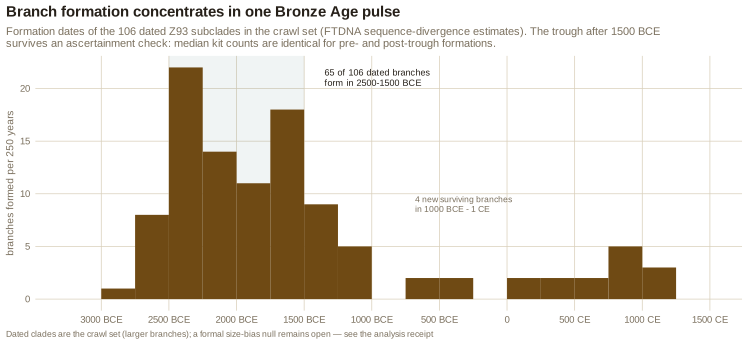
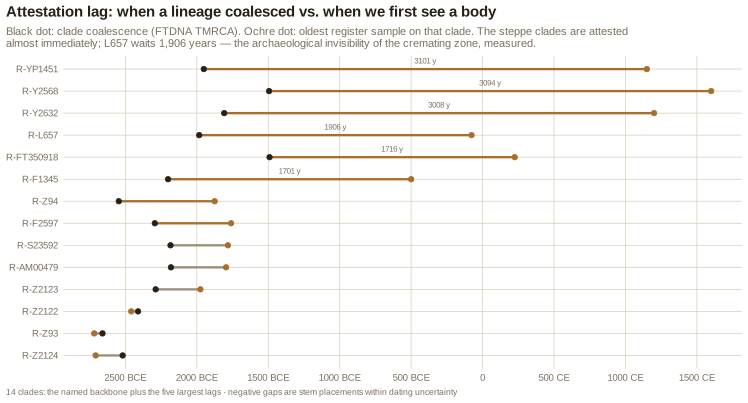
FTDNA's tree carries formation and coalescence estimates with 68% confidence intervals for every node, computed from sequence divergence independently of any archaeological or historical input. That independence makes the following alignments informative rather than circular — with the standing caution that a coalescence date records when surviving lines last share an ancestor, not when a population moved, and that alignment is not causation.
| Lineage | Coalescence (68% CI) | Documented horizon | Correlate |
|---|---|---|---|
| R-Z93 | 2660 BCE [3008–2356] | Fatyanovo–Abashevo forest-steppe, c. 2900–2100 BCE | Coalescence precedes the first Sintashta fortified settlement by five to eight centuries (radiocarbon corpus 2200–1770 calBC; Sintashta II early phase 2004–1852 calBC). The structure is older than the culture that amplified it. |
| Z94 → Z2124 → Z2122/Z2125 radiation | four nodes, 2660–2415 BCE, overlapping CIs | pre-Sintashta | A multifurcation compressed into roughly two centuries — the "burst" regime Poznik and colleagues (2016) identified as the dominant mode of male-line expansion — completed before the Sintashta horizon opens. Sintashta amplified existing branches; it did not create them. |
| R-L657 | 1983 BCE [2300–1707] | Steppe-to-South-Asia transfer window, 1900–1500 BCE | Coalescence sits at the opening of the narrow window Narasimhan and colleagues (2019) derive for steppe ancestry reaching South Asia (Swat admixture dates ~1900–1500 BCE; R1a-Z93 at 100% in Central_Steppe_MLBA males). First physical attestation follows twelve centuries later (Butkara II, 801 BCE). |
| R-Y2631 | 930 BCE [1297–617] | Cimmerian–early Scythian transition, 9th–7th c. BCE | Coalescence in the pre-Scythian Pontic transition; carriers appear in Middle Don Scythian-period burials by 375–300 BCE (Andreeva 2025), alongside Y3-arm men — the western steppe's Iron Age carried both arms. |
| Z2124 subclades in the Carpathian Basin | register cluster 350–900 CE | Hun, Avar and Hungarian-conquest arrivals, 5th–9th c. CE | Maróti and colleagues (2022): the Hun immigrant-core males carry R1a-Z94, 10 of 23 European Hun Y calls are Z93, one Late Avar cemetery holds three Z94 men on European genomes, and conquest-period Z94 carriers show Hun-related autosomal ancestry. The register's seventeen Hungary samples are the physical trace of this documented sequence. |
| Y3-arm men, Volga-Kama | four samples, c. 900 CE | Karayakupovo horizon — the Magyar source population | Gyuris and colleagues (2025) identify the Volga-Kama Karayakupovo communities as the primary source of the 10th-century Hungarians; four Y3-arm men sit inside that milieu, 2,500 km northwest of the arm's modern center of gravity. |
| R-MF84025 (below L657) | 756 CE [493–977] | early-medieval South Asian founder class | One of many young, high-frequency South Asian founder clades in the age class Balaresque and colleagues (2015) documented across Asia — eleven descent clusters expanding 2100 BCE–1100 CE, the historical-period ones concentrated in pastoral-nomad polities, the extreme case being the ~1000-year-old star cluster of Zerjal and colleagues (2003). |
| Kyrgyz Z2125 double founder | ~1200 CE (community TMRCA estimates) | Mongol imperial consolidation, 13th c. | Two stacked founder clusters dating to the Mongol era, in the same age class and social mechanism — hereditary elite reproductive advantage — as the Zerjal cluster. Community-derived dates; graded interpretive. |
The pattern across the table is a three-pulse structure: branch formation in the East European forest-steppe c. 2700–2400 BCE; amplification and southward transfer through the Sintashta–Andronovo world c. 2100–1500 BCE; then a long sequence of historically documented founder events — Scythian, Hunnic, Magyar, medieval South Asian, Mongol-era — each of which left a dated, named signature in the tree. This is the same punctuated regime Poznik and colleagues identified genome-wide, here resolved to a single haplogroup against a documented political history.
Eight Best Guesses, Graded
Four frontier models read the full data brief under different lenses — steppe archaeology, formal phylogeography, adversarial skepticism, and South/Central-Asian historical synthesis — and this is where they converged. "Well-supported" means the claim holds in multiple datasets and survived adversarial review.
- Z93 coalesces in the Eastern European forest-steppe, c. 3100–2600 BCE — plausible. The oldest carriers are all Volga–Oka–Ural men on basal lineages; nine samples from one region cannot exclude an origin further east.
- The Sintashta transition amplifies the Z2124 arm, c. 2200–1800 BCE — well-supported as amplification, not origination.
- Andronovo networks carry Z2124 east, c. 1800–1500 BCE — well-supported; Kazakhstan reaches parity with Russia, and Xinjiang's first appearance (~1566 BCE) belongs to this pulse.
- The southern arm departs toward the subcontinent in the same window — plausible in timing, unsampled in route. Butkara II proves arrival by the early Iron Age; everything between the steppe and Swat is a sampling gap. Andreeva's Middle Don men add a useful complication: the Y3 arm was still present in the western forest-steppe in the Iron Age, with no paternal continuity from the local Srubnaya population — movement on multiple fronts, not a single southbound departure.
- Inside South Asia, endogamy amplifies L657 into the subcontinent's largest R1a subclade — well-supported as a social process; its Bengali and Sri Lankan extensions track later historical movements, its Gulf presence is modern labour migration.
- Saka–Scythian consolidation spreads Z2125/Z2123/S23592 across the eastern steppe, c. 850–150 BCE — well-supported at horizon level; tying clades to named tribes (Yuezhi, Wusun) stays speculative without Ili-valley ancient DNA.
- The Hun–Avar era returns Z2124 lineages to Europe, c. 350–900 CE — well-supported broadly; distinguishing Hun from Avar from incorporated groups is beyond Y data alone.
- Medieval founder events reshape the modern map — plausible, community-quantified: project analyses attribute the Kyrgyz Z2125 peak to two stacked founder clusters with TMRCAs near 1200 CE, and Pashtun R1a to a young pan-tribal cluster (TMRCA ~0 CE) over an older diverse substrate — testable hypotheses not yet in the literature.
Where the lenses disagreed, the disagreement is the finding: the archaeology lens reads the Z2124 rise as expansion; the adversarial review reproduces most of it from coverage, burial visibility and drift; the resolution is that the direction is real across three independently biased datasets while every rate remains model-dependent.
Falsifiable Predictions
- Pre-2350 BCE samples from central/eastern Kazakhstan stay Z2124-negative if the Urals-region formation reading is right; one early eastern Z2124 man falsifies it.
- Future LBA/early-Iron sampling of the Hindu Kush–NW subcontinent corridor yields Y3/L657-side men at substantial frequency among Z93 carriers; continued read-level absence would force late-entry models.
- Read-level re-analysis of high-coverage "Z94*" steppe genomes moves men below Y3 or Z2124 — the basal pile is partly a coverage artifact and should shrink.
- Deep sequencing of Kyrgyz Z2125 keeps collapsing into few clusters younger than 1000 CE, if the medieval-founder reading is right, rather than a diverse Iron Age spectrum.
Method, Data and Code
Modern layer: two independent tester censuses, both read 2026-08-18. FTDNA's public haplotree bulk endpoint yields the complete Z93 subtree — 1,867 subclades, 8,417 kits (2,246 Big Y), per-node country tags — which drives the modern-map chart. The YFull v14.05.00 tree pages for Z93 and nine subclades were retrieved the same day and every sample flag extracted per subtree; ten mutually exclusive strata were computed by multiset subtraction, and the partition reconciles exactly with the Z93 total (1,085 = 1,085). Ancient tracking: alongside the AADR audit, FTDNA Discover's per-clade ancient panels were crawled across the subtree and deduplicated into a running register of ancient Z93 samples with terminal clade, site, coordinates, date and source study — published below and maintained as new clade pages surface samples. Ancient layer: a project audit joining every usable ancient male Y call in AADR v66 to the YFull tree (males only, QC-filtered, deduplicated; n=212), aggregated in R — era tables, Fisher tests, logistic trend, correspondence analysis, Shannon diversity. Independent check: a third-party community re-analysis of the Akbari 2026 raw sequences (whose own release contains no Y calls); its calls are unrefereed and used only as a shape-check, never for individual claims. Charts: ggplot2, one chart per claim, shared scales on small multiples.
- Ancient era × clade row-level table — 212 males with sample IDs, dates, localities, publications.
- Modern country × stratum matrix.
- Full R analysis output — every test in this page, with its numbers.
- FTDNA haplotree modern census — 114 countries × three arms, from all 1,867 Z93 subclades.
- FTDNA register replication analysis — era × arm table, independent logistic trend (p = 0.012), the full Y3-arm ancient roster, and the modern-inversion Fisher test.
- FTDNA Discover ancient register — 363 deduplicated ancient Z93 samples (one archaic reference individual removed in cleaning) with terminal clade, site, coordinates, date, culture and source study (of ~665 Discover counts under Z93; the remainder sit on small uncrawled branches). Largest sources: Akbari 2026 re-calls (173), Narasimhan 2019 (30), Gnecchi-Ruscone 2021 (21).
- External: UYSD (peer-reviewed per-country SNP frequency maps; Europe-weighted) · YFull R-Z93.
Interpretation caveat, stated once and meant everywhere: tester flags record who tests, excavation records record who was buried and dug, and no Y tree encodes language or ethnicity. The convergence of three differently-biased datasets is the strongest statement this page makes; every migration sentence above it is a graded hypothesis, and the predictions section is how they die.
Primary references
- Underhill et al. 2015 — the only broad per-population R1a subclade survey (16,244 males).
- Pamjav et al. 2012 — discovery of the Z282/Z93 split.
- Behar et al. 2013 — regional R1a clade table; the Levite M582 lineage.
- Haber et al. 2012 — Afghan ethnic-group frequencies.
- Chang et al. 2023 — Hui Z93 frequencies, Xinjiang/Ningxia.
- Keyser et al. 2020 — Xiongnu cemetery Y-lineages.
- Narasimhan et al. 2019 — Steppe_MLBA and the Swat transect.
- Akbari et al. 2026 — the 10,016-genome release (no Y calls published; see Method).
- Andreeva et al. 2025 — Middle Don Scythians; R-Y2 and R-Y2631 predominant, no Srubnaya paternal continuity (with the March 2026 erratum, which does not touch the Y calls).
- Ghalichi et al. 2026 — elite dynastic rule among Iron Age steppe nomads; the kurgan-visibility mechanism measured directly.
- FTDNA Discover R-Z93 — sequence-level re-calls of published ancients and the tester census used for the cross-checks above (read 2026-08-18).
- Poznik et al. 2016 — punctuated bursts as the dominant mode of male-line expansion.
- Zerjal et al. 2003 — the ~1000-year-old star cluster; social selection on a single patriline.
- Balaresque et al. 2015 — eleven Asian descent clusters, 2100 BCE–1100 CE.
- Maróti et al. 2022 — Hun/Avar/conquest-period Y lineages in the Carpathian Basin, incl. R1a-Z94 in the Hun immigrant core.
- Gyuris et al. 2025 — the Karayakupovo horizon as the Magyar source population; Volga-Kama cemeteries.
- Epimakhov et al. 2023 — Southern Urals Bronze Age radiocarbon chronology; Sintashta phase 2004–1852 calBC.
- Ralf et al. 2025 — the Universal Y-SNP Database.